— Documentation Standards
The Ulbak methodology describes how nutritional research is sourced, evaluated, documented, and revised. It covers the full arc from initial supplier identification through to archive entry publication and ongoing revision control.
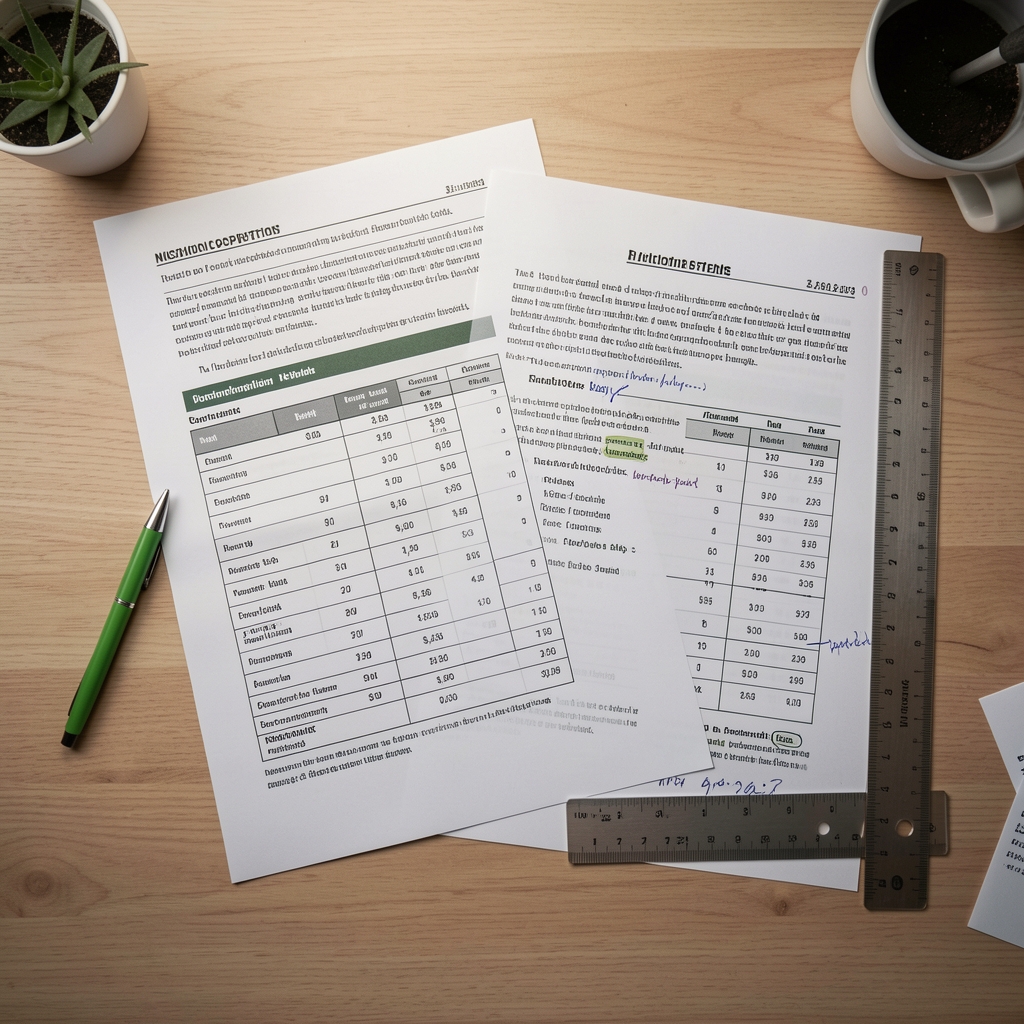
Process record — methodology review cycle, revision 07-C
— 01 / Process Steps
Each entry in the Ulbak archive passes through a defined sequence of stages before publication. The stages are not optional — every entry completes every step, regardless of topic or author. The sequence is documented here in its current revision.
Stage duration: 1–3 days
The research editor identifies relevant published nutritional literature through indexed databases covering sports nutrition, food science, and dietary research. Sources are selected based on study design quality, publication date, and specificity to male adult physiology. Grey literature and non-peer-reviewed sources are flagged separately and used for contextual framing only.
Stage duration: 2–5 days
Active ingredients are sourced from documented suppliers. The sourcing analyst reviews available supplier documentation, assessing chain-of-custody records, lot traceability, and food-grade processing standard adherence. Active ingredients are sourced from documented suppliers, with each batch accompanied by a certificate of composition. Sourcing prioritises suppliers whose facilities maintain food-grade processing standards.
Stage duration: 3–7 days
Ingredient profiles in Ulbak supplements are selected based on published nutritional research and undergo independent batch verification for quality and labelling accuracy. Third-party verified compositional data is cross-referenced against the research claims documented in Stage 1. Discrepancies are recorded in the entry's verification notes field and flagged for editorial review.
Stage duration: 2–4 days
The editorial correspondent drafts the archive entry, translating the research documentation and sourcing data into the observational register characteristic of the Ulbak archive. Each claim in the draft is tagged with a source annotation. Marketing language, superlative phrasing, and unqualified assertions are removed at this stage.
Stage duration: 1–2 days
The lead research editor reviews the draft against the source annotations and sourcing documentation. Register adherence, accuracy of summary, and completeness of the verification record are assessed. Entries that do not pass this stage are returned to the drafting stage with a written review note. The review note is retained in the archive record.
Stage duration: 1 day
Approved entries receive a batch code in the format YYYY-QN-NN, a revision number (starting at 01-A), and a publication date. The batch code links the entry to the supplier and verification documentation held in the archive's internal record system. The entry is then published to the live archive.
Quarterly review
Published entries are reviewed on a quarterly basis. When the supporting nutritional literature changes materially, the entry is revised: source annotations are updated, a new revision number is assigned (e.g., 01-A becomes 02-A), and the revision date is recorded. The prior version of the entry is retained in the internal archive record but not displayed publicly. Entries are flagged rather than deleted.
— 02 / Sourcing
The sourcing framework describes the minimum documentation requirements a supplier must provide before their material is included in any Ulbak archive entry. The framework has been in operation since the archive's establishment in 2019 and is reviewed annually.
Required — all batches
Each batch of ingredient material must arrive accompanied by a certificate of composition issued by the supplier. The certificate specifies the elemental profile, moisture content, and lot reference number. Certificates are retained in the archive's sourcing documentation file for the lifetime of the associated entry.
Required — new suppliers
New supplier relationships require submission of a chain-of-custody record tracing the material from point of origin through to the processing facility. The record must identify the regional growing or extraction location. Named-region material is preferred; anonymous-origin material is accepted only when chain-of-custody is otherwise complete.
Required — preferred suppliers
Preferred suppliers demonstrate independent laboratory verification of their compositional claims. The laboratory conducting the verification must be independent of the supplier — internal testing documentation is accepted as supplementary but not as a substitute for third-party assessment.
Required — ongoing
Sourcing prioritises suppliers whose facilities maintain food-grade processing standards. Evidence of processing standard adherence is reviewed at the point of supplier onboarding and at each annual sourcing review. Suppliers whose documented adherence lapses are placed on probationary status pending updated documentation.
— 03 / Verification
Ingredient profiles in Ulbak supplements are selected based on published nutritional research and undergo independent batch verification for quality and labelling accuracy. The verification protocol specifies what is checked, who checks it, and how discrepancies are handled.
Elemental concentration is the primary verification target. For micronutrients covered in the archive — zinc, magnesium, vitamin D3, selenium, B12, omega-3 fatty acids — independent compositional analysis confirms that the stated concentration in the certificate of composition corresponds to the actual measured content of the batch.
Where independent analysis produces a result outside a defined tolerance range, the batch is removed from the archive's sourcing record and the associated supplier is placed on review status. The discrepancy is documented in the supplier's record file. No entry in the archive references a batch that has not passed verification within its stated tolerance.
"Verification is not a quality signal used in marketing copy. It is a documentation requirement used to maintain archive accuracy."
— Verification Standards Record, Revision 03-B, 2024
— 04 / Archive
Each entry in the Ulbak archive follows a standardised structure. Consistent structure enables cross-referencing between entries and allows the revision history to be maintained without disrupting readability.
Batch code, revision number, publication date, and last-reviewed date. The header provides the full temporal context for the entry and links it to the internal sourcing documentation record.
A concise summary of the ingredient's documented role in supporting normal physiological functions — energy metabolism, immune support, cognitive function, or cellular processes. Language is drawn from the approved register vocabulary.
Numbered references to the published research used to support the nutritional summary. Each annotation identifies the study, the relevant finding, and the year of publication. Contested findings are noted with a range of referenced positions rather than a single conclusion.
Supplier region of origin, lot reference number, and certificate of composition reference. This field links the editorial entry to the physical sourcing documentation held in the archive's internal system.
Results of independent batch verification, including the laboratory reference, the test date, and whether the result fell within the defined tolerance range. Discrepancies are documented here rather than removed from the record.
A log of all revisions made to the entry since first publication. Each log line records the revision number, the date, and a brief note on what changed and why. The log is preserved permanently in the internal archive — entries are updated, not overwritten.
— Regulatory Position
Ulbak products are nutritional food-supplements registered with the applicable local regulatory authority under food-supplement classification. Products meet compositional and labelling requirements for nutritional supplement categories.
We recommend speaking with a qualified wellness or nutrition professional before introducing any supplement to your daily routine, particularly if you have specific dietary requirements.
— View the full archive
The services and programs page lists each active research track, the nutrients covered, and the current batch record status for each area.
View Programs— 05 / FAQ
Revision numbers provide a stable reference point that does not change when the date is updated. A reader citing the archive in their own notes can specify "Revision 02-A" with confidence that this refers to a specific version of the entry. Date-only updates do not offer this precision — a date tells you when, but not what changed or how significantly.
Contradictory findings trigger a review of the relevant entry. If the new research is materially significant and comes from a robust source, the entry is revised to reflect the updated picture — including a note on the nature of the contradiction. Where the research landscape is genuinely contested, the entry documents the range of findings rather than adjudicating between them.
It refers to facilities that handle ingredients in conditions designed to prevent contamination, mislabelling, and compositional degradation. The term is used in its food industry sense: controlled environments, documented cleaning and separation protocols, and regular third-party facility audits. The sourcing framework does not specify which accreditation body is used — adherence to the standard is what is required, not a specific badge.
Requests for internal batch documentation are reviewed on a case-by-case basis. The editorial team handles these as archive access inquiries — submit your request through the contact form, selecting "Archive Research Access" as the subject. The sourcing analyst will identify what documentation is available and advise on next steps.